The HH:MM:SS conversion formula decomposes any nonnegative whole number of seconds into hours, minutes, and seconds using three floor divisions: hours = floor(total seconds ÷ 3,600), minutes = floor((total seconds mod 3,600) ÷ 60), and seconds = total seconds mod 60. The formula is the standard way to express an elapsed duration in SI seconds as a human-readable string, where 1 hour equals 3,600 seconds and 1 minute equals 60 seconds, as defined in the BIPM SI Brochure. Unlike a clock-time format that wraps hours at 24, this conversion retains every full hour so multi-day durations stay reversible: multiplying hours by 3,600, minutes by 60, and adding the seconds field returns the original total exactly. The arithmetic runs on integer remainders rather than rounded decimals, which means no floating-point tail appears in the output. The formula is the backbone of any tool that formats elapsed seconds for logs, timers, exercise records, media durations, job runtimes, and simple data cleanup. It does not account for calendar concepts such as dates, time zones, daylight saving time, leap seconds, or months.
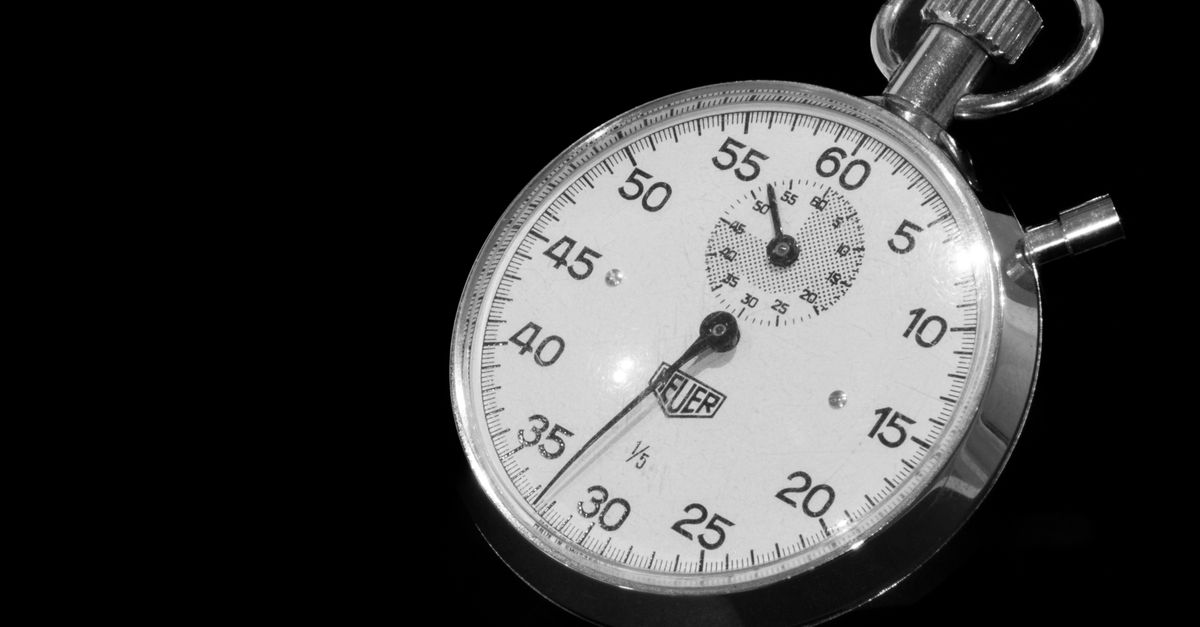
The Three Variables in the Conversion Formula
The formula takes a single input and produces three output variables. Understanding what each variable represents is what makes the formula easy to audit when it appears in code or documentation.
The first variable is H, the hours field. It is calculated as floor(total seconds ÷ 3,600), so it counts every complete hour in the elapsed duration. For an input of 98,765 seconds, H becomes 27 because 27 × 3,600 = 97,200 whole seconds are absorbed into hours, leaving a remainder that is smaller than one full hour.
The second variable is M, the minutes field. It is calculated as floor((total seconds mod 3,600) ÷ 60). After the hours have been removed, the remaining seconds are divided into complete minutes. M is bounded between 0 and 59 because every full 60-second chunk is lifted out as one minute; the constraint is built into the remainder, not added later.
The third variable is S, the seconds field. It is calculated as total seconds mod 60. Whatever remains after hours and minutes is the seconds field, and it is also bounded between 0 and 59 by construction. The notation HH:MM:SS is just a layout convention: ordinary values of H are padded to two digits (so 1 hour reads 01), M and S are always two digits, and H may grow past two digits when the duration spans a day or more.
| Aspect | Elapsed-duration formula | Clock-time format |
|---|---|---|
| Hour field range | Unbounded; can exceed 99 | 00 to 23 |
| Day meaning | Not used | Day rollover implied at 24:00 |
| Reversibility to seconds | Exact: H × 3,600 + M × 60 + S | Needs day count or epoch reference |
| Time zones | None applied | Must be applied separately |
| Daylight saving | None applied | May shift the value by one hour |
| Leap seconds | None applied | None applied |
| Output style | HH:MM:SS, hours may grow | HH:MM:SS, hours capped at 23 |
Padding and Formatting Conventions
The formula decides which integer goes in which slot, but a separate set of formatting rules decides how each slot is written. Ordinary hour values are padded to two digits so a single-digit hour scans at the same width as a multi-digit one: 1 hour becomes 01, 9 hours becomes 09, 10 hours stays 10. This matches the conventional HH:MM:SS layout and makes column-aligned displays line up cleanly in logs and reports.
Minutes and seconds are always two digits, with values below 10 padded with a leading zero. This is forced by the remainder arithmetic: M and S are guaranteed to be between 0 and 59, and a two-digit display removes the visual ambiguity that a single-digit field would introduce. Hours can grow beyond two digits; a 125-hour duration is displayed as 125, not truncated to 25. Truncation would discard elapsed time and make the output non-reversible.
Apply the Formula to a Whole Number of Seconds
- Read the input as a nonnegative whole number of seconds, with no decimals and no negative sign.
- Compute H = floor(input seconds ÷ 3,600) and store the integer as the hours field.
- Compute the post-hour remainder with input seconds mod 3,600 and store it as R.
- Compute M = floor(R ÷ 60) and store the integer as the minutes field.
- Compute S = R mod 60 and store the integer as the seconds field.
- Format the output as HH:MM:SS, padding H to two digits for ordinary values and leaving H at its full width once it exceeds 99, while always padding M and S to two digits.
Worked Example: 98,765 Seconds
Running 98,765 through the formula gives 27:26:05. Here is the arithmetic in full, step by step.
H = floor(98,765 ÷ 3,600) = floor(27.4347…) = 27. The 27 absorbs 27 × 3,600 = 97,200 seconds.
R = 98,765 mod 3,600 = 1,565. M = floor(1,565 ÷ 60) = floor(26.0833…) = 26. The 26 absorbs 26 × 60 = 1,560 seconds.
S = 1,565 mod 60 = 5. Formatted: 27:26:05.
To verify, compute 27 × 3,600 + 26 × 60 + 5 = 97,200 + 1,560 + 5 = 98,765. The formula is reversible.
A duration of 98,765 seconds is intentionally not shown as 03:26:05, which would discard a full day. The output preserves total elapsed time so it can be read back into the original count of seconds without ambiguity. A practical tool that applies this formula is the Seconds to HMS Converter, which performs the same three floor divisions and exposes the H, M, and S fields on a copyable breakdown card without wrapping the hour field at 24.
Where the Formula Fits
The conversion is the standard way to express elapsed SI seconds in many practical contexts. Logs, timers, exercise records, media durations, job runtimes, and test output all benefit from the HH:MM:SS format because the human eye can scan a colon-separated string far faster than a raw integer of seconds.
For media durations, the formula is what most video and audio players expose through their metadata inspector or duration API. For exercise records, the formula turns a wearable's second count into a run or workout summary. For job runtimes, the formula gives a scan-friendly total for build pipelines and batch jobs, and the reversibility property means a glance at the result is enough to estimate the original integer without looking at the source code.
The formula deliberately does not interpret the duration as a clock time. It does not apply time zones, does not observe daylight saving transitions, does not insert leap seconds, and does not reconcile with month lengths. The arithmetic only describes the count of elapsed SI seconds, as referenced by NIST's writing guidance for SI units.
Limits and Excluded Inputs
The formula has three practical limits that change which inputs are accepted.
First, the input must be a nonnegative whole number of seconds. Decimals like 1.5 seconds fall outside the formula because fractional seconds require a separate precision and separator convention (milliseconds, microseconds, or another unit). A value such as 1.5 seconds could be represented as 1500 milliseconds, but that mixes a unit change with a precision change, which is outside the formula's scope. For decimal seconds, milliseconds, or microseconds, a dedicated time-unit converter should be used instead of this formula.
Second, negative values are rejected. The formula describes an elapsed interval, which is nonnegative by definition; signed offsets belong on a different axis and are not part of this conversion.
Third, the input must stay within the largest safe integer that can be represented exactly: 9,007,199,254,740,991. Beyond that ceiling, adjacent integers collapse to the same floating-point value and could silently produce a wrong seconds field. The explicit limit favors an auditable error over a plausible but imprecise timestamp. Every integer within the limit is represented exactly, so no precision is lost during the floor divisions.
If a destination needs days plus a 00–23 clock field, divide the total separately or use a duration formatter that exposes a days component. If it needs ISO 8601 duration syntax such as PT27H26M5S, do not relabel the colon string; emit the syntax the destination requires instead of treating HH:MM:SS as a substitute.
Reversing the Formula Back to Seconds
Because the formula uses floor division and exact remainders, the output is fully reversible. To recover the original count of seconds from an HH:MM:SS string, multiply the hours field by 3,600, multiply the minutes field by 60, then add both values and the seconds field.
For 27:26:05, that means 27 × 3,600 + 26 × 60 + 5 = 97,200 + 1,560 + 5 = 98,765 seconds. The reversibility is what separates an elapsed-duration output from a clock-time output: a clock-time string such as 03:26:05 cannot be converted back to seconds without first knowing which day it occurred on, while an elapsed-duration string always maps back to a unique integer.
A practical use of reversibility is data cleanup. With a column of HH:MM:SS strings in a spreadsheet or a log file, multiplying hours by 3,600 and minutes by 60 and adding the seconds field gives a sortable integer that can be compared across rows. This is the same shape the formula uses for sorting runtimes, ranking exercise records, or grouping media clips by length, and it works without any external lookup table.
Related reading: How to Find Sector Area: Formula, Units, and Steps.
Related reading: How to Convert Time to Hours: Formulas and a Free Tool.