Compare the source limits, the Bass, Mid, and Treble settings from -12 to +12 dB, the processed peak level, the exported format, and a level-matched preview before using an audio equalizer. The goal is not merely to find a setting that sounds louder; it is to make a controlled tonal change without clipping, truncating the file, or losing track of what the processor did. The Audio Equalizer provides a compact three-band peaking EQ for one local file, with Bass at 100 Hz, Mid at 1,000 Hz, and Treble normally at 10,000 Hz. Check browser decoding and every input limit first, then compare the raw peak, output peak, safety scale, sample rate, frame count, and final WAV properties. Combined boosts can push the processed signal above digital full scale, so a uniform scale may be applied across every channel rather than clipping isolated peaks. Finally, listen to the preview and original at a similar perceived level, because a louder file can conceal unwanted noise, sibilance, rumble, or distortion. Used in that order, these comparisons show whether the result is technically complete and musically appropriate.
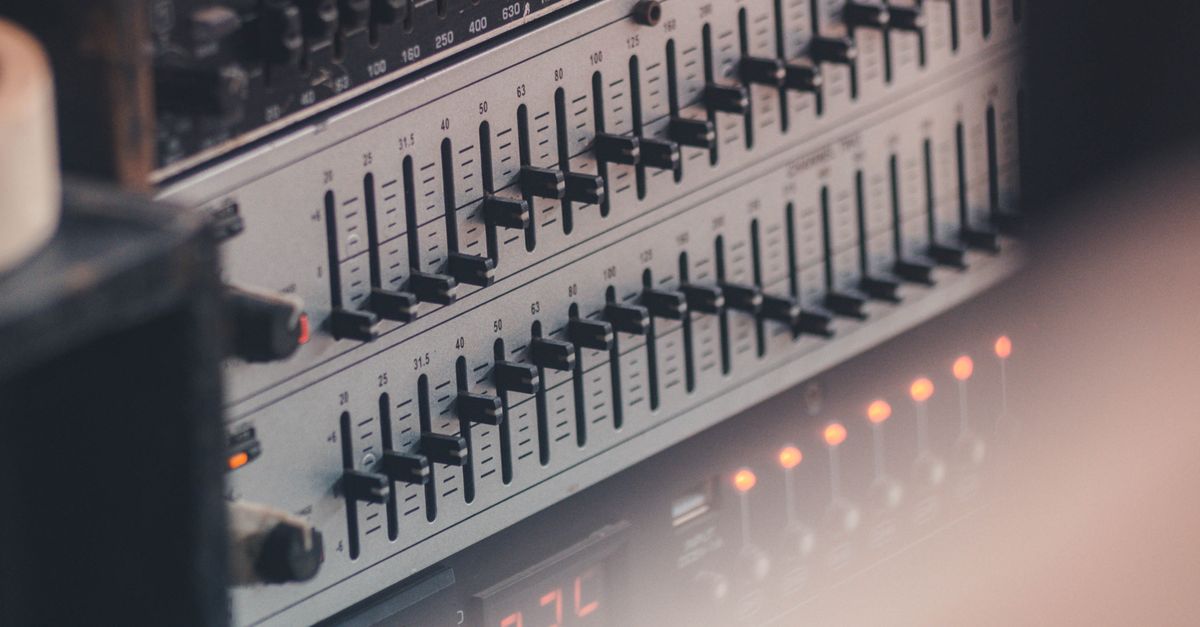
Check the Source Before Processing
Input compatibility is the first comparison. The tool relies on the browser’s Web Audio decoder and can attempt MP3, WAV, M4A, AAC, Ogg, WebM, and FLAC, but the current browser and operating system must support the actual codec. A familiar extension is not enough because a container can hold a codec the browser cannot read.
The limits protect the tab from unexpectedly large decoded data. An over-limit file is rejected before filtering, the ending is never silently truncated, and a decode failure produces an error rather than a stale download.
| Source measure | Accepted requirement | What to compare |
|---|---|---|
| Input size | 50 MiB maximum | An oversized source is rejected before filtering. |
| Decoded duration | Five minutes or shorter | The file is not trimmed at the end to meet the limit. |
| Channel count | One through eight channels | Every accepted channel is filtered independently with identical settings. |
| Decoded sample rate | 8,000 through 192,000 Hz | This is the rate used for processing and written to the WAV, not necessarily the source container’s claimed rate. |
| Decoded workload | No more than 30 million channel samples | The total decoded sample data stays within the tool’s safety budget. |
| Codec support | The browser must decode the actual codec | A failed decode produces an error and no stale download. |
Compare the Three Bands by Their Actual Function
Once the file is eligible, compare the intended change with how each control works. Bass, Mid, and Treble accept whole-number gains from -12 through +12 dB. Positive values boost energy around a band center, while negative values cut it. These are broad peaking regions, not hard frequency boundaries. Each filter uses Q=1, a disclosed broad setting that is not inferred from the recording and cannot be changed on the page.
The disclosed implementation converts each gain into the coefficient defined by the W3C Audio EQ Cookbook, normalizes the coefficients by a0, and applies a second-order recursive filter to every decoded channel. The sections run in Bass, Mid, then Treble order. At zero on all three controls, the tool follows a genuine flat path and copies the decoded channel samples without running a nonzero filter section.
| Control | Disclosed center | Allowed gain | What the adjustment affects |
|---|---|---|---|
| Bass | 100 Hz | -12 to +12 dB | Energy around a broad region centered at 100 Hz. |
| Mid | 1,000 Hz | -12 to +12 dB | Energy around a broad region centered at 1,000 Hz. |
| Treble | min(10,000 Hz, floor(decoded sample rate × 0.45)) | -12 to +12 dB | Normally 10,000 Hz; at lower sample rates, the center moves below the Nyquist limit. |
Run the Equalizer Locally
- Choose one browser-decodable file. Before applying any gain, confirm that the file is no larger than 50 MiB and that its decoded data is no longer than five minutes, has one through eight channels, uses 8,000 through 192,000 Hz, and contains no more than 30 million channel samples.
- Set Bass, Mid, and Treble. Enter a whole-number value from -12 through +12 dB for each band. Keep a control at 0 when you do not want that band changed, and compare all three settings with your tonal goal before applying them.
- Apply the equalizer locally. The filters process the decoded channels in the current browser tab. The source is not uploaded, and Lizely does not receive the audio bytes, decoded samples, EQ settings, filename, or result.
- Inspect the processing numbers. Check the raw peak, output peak, exact safety scale, decoded sample rate, and frame count. The interface also reports the band centers and byte count, providing a compact technical record of the run.
- Preview, compare, and download. Preview the processed result, compare it with the original at a similar perceived level on the speakers or headphones that matter, and then download the complete new PCM16 WAV. If decoding failed, correct the source or choose another file; the tool presents an error and no stale download.
Read Peak Safety and Scaling Correctly
Compare peak values before trusting the preview. The raw peak is the largest absolute sample magnitude across every processed sample and every channel. The output peak is the value after any safety adjustment, while the safety scale reports the exact uniform factor applied to the entire processed result.
If the raw peak exceeds 0.99, every processed sample and channel is reduced by one uniform scale so the largest magnitude becomes 0.99. This prevents the PCM encoder from independently chopping individual peaks, but it can lower the overall level. It is not loudness normalization: the safety scale does not target LUFS, RMS, replay gain, or a streaming-platform specification.
Verify the Downloaded WAV
Verify what the download preserves. The output is a new uncompressed PCM16 WAV: float samples are converted to signed 16-bit little-endian PCM and interleaved by frame. Its header records the actual channel count, decoded sample rate, byte rate, block alignment, bit depth, and complete data length. Every channel keeps the same number of sample frames, and all accepted channels receive identical filter settings.
Do not expect the original container details to survive. The download does not retain the source MP3 or AAC bitrate, compression mode, tags, artwork, chapters, loop markers, or container metadata. Web Audio may resample while decoding, so compare the reported decoded rate with your expectation instead of assuming that the source container rate was preserved unchanged.
Compare the Sound at a Similar Level
The preview and reported numbers are checks, not proof of a desirable mix. Listen for whether the intended band sounds clearer without making another problem dominant. Strong boosts may emphasize source noise, sibilance, rumble, or distortion that was already present.
Compare against the original at a similar perceived level, not merely by volume. A cut is often safer than stacking several boosts. Make the final judgment on the playback system you will actually use, because speakers and headphones can reveal different balance problems.
Recognize the Limits of This Equalizer
This processor is a compact three-band peaking equalizer, not a graphic 10-band system, a linear-phase mastering processor, an automatic room-correction system, or a promise that one setting improves every recording. Its fixed Q=1 provides broad adjustment, but it cannot address a narrow problem with a precisely selected frequency and bandwidth.
Use a full audio editor when you need exact custom center frequencies, adjustable Q, spectrum analysis, automation, linear-phase processing, loudness metering, dithering controls, codec selection, or metadata preservation. For a controlled three-band tone adjustment with local processing, peak protection, and a complete WAV export, the Audio Equalizer matches this narrower task without implying room correction or mastering.
Related reading: What Should I Compare Before I Use Audio Speed Changer?.
Related reading: What to Do If You Cannot Use an Audio Equalizer.